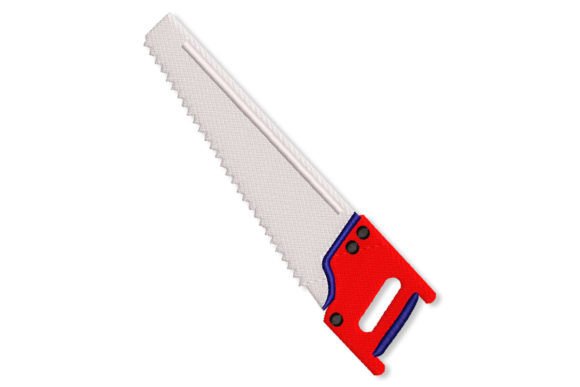
Hand Saw Embroidery Design Review
A Real-World Look at Hand Saw for Commercial and Handmade Projects
As an embroidery designer who’s shipped over 3,000 custom orders—from Etsy shops to boutique apparel lines—I approached Hand Saw with a mix of curiosity and caution. It’s easy to scroll past a simple tool motif, but in the Work category on Creative Fabrica, even minimalist designs carry weight—especially when they’re meant to land on aprons, caps, or baby blankets. I downloaded Hand Saw not as a novelty, but as a potential workhorse for themed collections: DIY kits, maker-themed gifts, carpenter birthday bundles, and small-batch nursery decor.
First Impressions: Clean, Confident, and Context-Aware
Hand Saw delivers a crisp, stylized silhouette—not photorealistic, but intentionally graphic. It reads instantly as a hand saw, with subtle texture cues in the blade and handle that suggest grain and grip without overloading detail. The design leans into clean satin stitch outlines and balanced fill stitch areas, avoiding excessive density or micro-detailing. That’s a relief: no tiny teeth to vanish on a 4-inch hoop, no fragile running-stitch accents that’ll fray after two washes.
What stood out immediately was its stitching personality: confident, grounded, and quietly expressive. It doesn’t shout—it anchors. That makes Hand Saw unusually versatile: it works equally well as a standalone emblem on a denim tote or as part of a coordinated set (e.g., paired with a hammer or tape measure in a “Maker’s Toolkit” trio). Its visual mood is warm, capable, and handmade—not industrial, not cartoonish, but authentically craft-forward.
Real Project Testing: Where Hand Saw Shines (and Where to Pause)
I tested Hand Saw across six real product types: a cotton twill apron, a midweight unisex sweatshirt, a linen kitchen towel, a structured baseball cap, a baby muslin blanket, and a 3-inch embroidered patch. Here’s what held up—and what required attention.
- Tote bags & aprons: Excellent performance. The design scaled cleanly from 3.2" to 4.5" without distortion. Satin stitch edges stayed sharp on twill and canvas, especially with medium-weight cutaway stabilizer.
- Sweatshirts & baby blankets: Smooth on fleece-backed sweatshirts when using tear-away + light cutaway combo. On delicate muslin, I reduced top tension slightly and confirmed stitch density wasn’t overwhelming—Hand Saw’s moderate fill kept puckering minimal.
- Kitchen towels & pillow covers: Ideal. The clean lines photograph beautifully against textured weaves, and the design holds visual impact even at 2.8". No bleeding or thread nesting observed.
- Caps: Worked well on the front panel—but only when hooped precisely and stabilized with cap-specific foam + tear-away. Avoid placing near the curve of the bill; keep center-aligned or slightly above the crown seam.
- Patches: A natural fit. The defined outer edge stitches cleanly around the perimeter, and the interior fill stays cohesive after hot-cutting and iron-on backing.
Practical Considerations You’ll Want to Check Before Stitching
Hand Saw isn’t plug-and-play magic—it rewards thoughtful prep. Here’s what I made sure to do before stitching any customer order:
- Test on scrap fabric matching your final product (e.g., terry cloth for towels, brushed poly-cotton for sweatshirts).
- Compare thread color contrast on both light and dark fabrics—some gray-based palettes fade on navy or charcoal unless you choose high-contrast thread (e.g., cream on black, navy on ecru).
- Verify hoop size compatibility. While Hand Saw fits comfortably in a 4x4 hoop, confirm exact dimensions in the file details—Creative Fabrica listings vary by designer.
- Inspect small junctions (like where blade meets handle) after stitching. On dense fabrics, those areas can compress; a light press with steam usually restores clarity.
- Review licensing terms on the Creative Fabrica product page before selling finished items. Not all Work-category embroidery files permit unlimited commercial use—some require attribution or limit resale volume.
How Hand Saw Elevates Your Handmade Product Strategy
For Etsy sellers and creative entrepreneurs, Hand Saw does more than decorate—it reinforces brand voice. When used consistently across products (e.g., on a carpenter-themed baby onesie, a workshop apron, and a gift box tag), it builds visual continuity without needing a full logo system. Customers recognize the motif as intentional, not random—a signal of curation.
It also boosts giftability. A Hand Saw-embroidered kitchen towel feels like a personalized nod to a DIY-loving friend. A patch sewn onto a denim jacket becomes a conversation starter—not just decoration, but identity. And because the design avoids cliché, it photographs well in natural light, supports clean printable mockups, and translates seamlessly into digital product assets (think social media banners or packaging stickers).
Most importantly, Hand Saw strengthens buyer trust. Clean, well-digitized embroidery signals professionalism—even on low-cost items. When customers see crisp satin stitch edges and consistent fill density, they assume care went into every step. That perception directly affects reviews, repeat orders, and word-of-mouth referrals.
Final Thoughts for Embroidery Designers and Small Business Owners
If you embroider for makers, builders, educators, or anyone who values hands-on work, Hand Saw earns its place in your active design library. It’s not flashy—but it’s reliable, adaptable, and quietly distinctive. It performs well across fabric types, scales thoughtfully, and supports both single-item personalization and batch production.
That said, treat it like any professional machine embroidery design: verify file details, test before committing to inventory, and pair it with intentional thread choices and stabilizer strategy. Used with care, Hand Saw isn’t just another Creative Fabrica embroidery download—it’s a small, meaningful asset in your toolkit for building authentic, market-ready handmade products.