Baby Cloud: A Playful, Practical Embroidery Design Worth Your Thread
First Impressions: Soft, Friendly, and Unmistakably Childlike
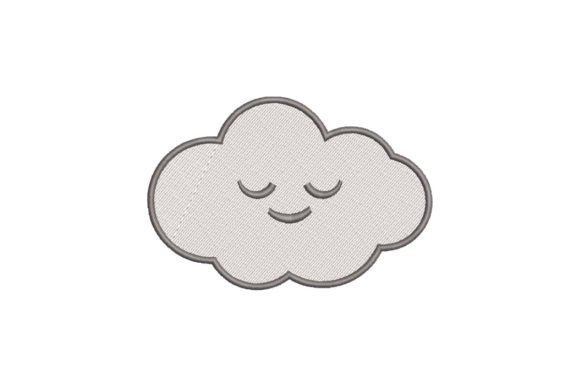
When I opened the Baby Cloud embroidery file, what struck me wasn’t just its simplicity—but its intentionality. This isn’t a generic cloud shape slapped together for speed. It’s rounded, gently asymmetrical, with subtle curvature that reads as soft and safe at a glance. The design leans into friendly minimalism: no sharp angles, no fussy details, no hidden complexity in the stitch path. That’s a win—not just aesthetically, but functionally. As a designer who’s stitched hundreds of clouds (yes, really), I know how easily they can tip from charming to cartoonish or worse—flat and lifeless. Baby Cloud avoids both traps. Its visual personality fits naturally in a nursery, on a toddler’s onesie, or as part of a curated set of baby embroidery designs—but it also holds up beautifully on adult-facing items like kitchen towels or minimalist tote bags.
A Real-World Test: Stitching It on a Linen-Cotton Baby Blanket
Last week, I used Baby Cloud on a custom order: a 30”x40” organic cotton/linen blend blanket for a new parent. We placed one centered near the bottom corner, sized at 3.2”, with light blue thread on off-white fabric. The result? Calm, cohesive, and quietly special. No glare, no puckering, no “stitched-on” stiffness—just a soft, dimensional accent that felt handmade without shouting about it. That’s where Baby Cloud earns its keep: it enhances without overwhelming. It doesn’t compete with fabric texture or pattern; it complements it. For Etsy sellers or boutique owners building a gentle, nature-inspired brand, this is exactly the kind of embroidery file that reinforces tone and trust—not just decoration.
Where It Shines (and Where to Pause)
Baby Cloud works exceptionally well on:
- Custom apparel: Sweatshirts, lightweight tees, and reversible bucket hats—especially when paired with other simple motifs (a tiny sun, a single raindrop).
- Baby embroidery: Onesies, burp cloths, and muslin swaddles—its scale and shape read clearly even at small sizes (2.5”–3.5”).
- Tote bag design and pillow covers: Its clean silhouette translates well across larger surfaces without needing reworking.
- Holiday embroidery and wedding gifts: Think cloud-adorned onesies for baby showers or linen tea towels for rustic-chic weddings.
- Embroidered patch prep: With moderate stitch density and no fine interior details, it presses cleanly and sews flat.
But—and this matters—Baby Cloud needs thoughtful placement on:
- Stretchy fabric (like jersey knits): Use cutaway stabilizer, not tear-away, and avoid high-stress seams. The curves hold up, but tension shifts can distort the outer satin stitch edge.
- Textured fabrics (burlap, heavy terry cloth): The fill stitch may sink slightly—test first. Consider simplifying the design by removing one layer of fill if needed.
- Dark fabric: Light-colored thread looks lovely, but check contrast in natural light. Some pale blues or creams lose definition on navy or charcoal.
- Curved surfaces (caps, beanies): It’s doable, but keep sizing under 2.8” and hoop with medium-density stabilizer to prevent shadowing.
Design Integrity Meets Commercial Sense
As someone who reviews embroidery files for craft businesses, I pay close attention to how a design affects perceived value—and Baby Cloud raises it. Its balance of simplicity and craftsmanship makes finished products feel intentional, not mass-produced. Customers notice that. On an Etsy listing, a well-stitched Baby Cloud on a handmade apron signals care—not just capability. It also scales gracefully across product types: same file, same confidence, whether you’re embroidering a single baby onesie or batch-producing 50 holiday tea towels for your small shop.
That said, don’t assume licensing covers resale. If you’re a digital embroidery file seller or plan to offer Baby Cloud as part of a bundle, verify commercial use rights before listing. And if you’re using it for client work—say, branding for a children’s boutique—confirm whether the file permits derivative use (e.g., combining it with custom lettering).
Practical Designer Notes You’ll Actually Use
Before stitching Baby Cloud into your next project, try these real-world checks:
- Test on scrap fabric—same type and weight as your final piece. Watch how the satin stitch wraps the edges.
- Review stitch density. If it feels heavy on lightweight cotton, reduce fill layers in your software (if editing is allowed).
- Confirm hoop size. This design likely fits comfortably in a 4”x4” hoop—but verify before hooping your good fabric.
- Inspect small details—especially the cloud’s underside curve. Does it stitch cleanly, or does thread nest? Adjust top tension if needed.
- Try black-and-white mockups. A grayscale preview reveals contrast issues faster than color.
- Use proper stabilizer: Medium-weight cutaway for knits, tear-away for stable wovens, and fusible + tear-away for nap-free fleece.
- Compare light vs. dark backgrounds in natural light—not just screen previews.
Final Thought: Not Just a Cloud—A Quiet Signature
Baby Cloud won’t dominate a collection or go viral on social media—but that’s its strength. It’s the kind of embroidery design that builds quiet recognition over time: the soft cloud on a favorite sweatshirt, the subtle accent on a handmade gift tag, the gentle motif customers remember because it *felt* right. For designers, craft business owners, and Etsy sellers building authenticity—not just inventory—it’s a reliable, versatile, and genuinely pleasant asset. Just remember: its charm lives in restraint, clarity, and careful execution. Stitch it with intention, and it’ll carry more meaning than its simple shape suggests.